
Quick Verdict: Can You Actually Build a SaaS with v0 or Lovable?
Every tech influencer on X and YouTube is selling the same 2026 fantasy: type a plain-English prompt into an AI chat box, sit back with a cup of coffee, and ship a production-grade micro-SaaS before lunch.
The reality? Thirty minutes in, you’re usually staring at a depleted credit meter wondering where your trial went, or untangling 52 uninvited npm packages in an enterprise monolith you never asked for.
The moment you sit down to build something real on v0 by Vercel or Lovable.dev, the marketing claims crash into hard technical trade-offs:
- On v0, you watch your trial balance quietly burn $1.00 every time you tweak a layout, wondering whether you’re building a real full-stack web application or just an interactive Figma mockup with zero backend.
- On Lovable, you get a complete full-stack dashboard with database schemas and auth modals, only to watch your daily credit meter slam shut after Prompt #2, leaving you with an enterprise TanStack Start + Nitro SSR codebase that takes 4 minutes to install.
So, which platform actually lets you ship—and which one is an expensive toy? Here is the direct, empirical verdict from our head-to-head build test:
- Choose v0 if you are a developer who wants pristine, modular Next.js code to drop into an existing repository. v0 authored a masterclass in modern frontend engineering: a Next.js 16 App Router codebase with just 11 direct dependencies, clean component isolation, and zero framework bloat. However, v0’s free tier is a one-time teaser, not a recurring allowance. It gives you a one-time $5 credit that burned $1.95 (39%) across our two prompts. In practice, v0 gives you roughly 5 generations in your lifetime before requiring a $20/month subscription.
- Choose Lovable if you want a complete, standalone full-stack MVP with state, database, and auth from a single prompt. Lovable was faster overall (3 minutes and 52 seconds total build time vs. v0’s 4 minutes 27 seconds), dynamically wired aggregate statistics across the entire UI, and offers daily replenishable credits (5 credits every 24 hours). However, building an interactive MVP tapped out 100% of our daily quota (5.10 credits burned), and its exported code is an enterprise TanStack Start + Nitro SSR monolith carrying 52 dependencies and 40 unused shadcn components.
The Master Benchmark Tally
| Benchmark Metric | v0 by Vercel | Lovable.dev | The Winner |
|---|---|---|---|
| Prompt 1 Scaffolding Time | 2 min 27 sec | 2 min 35 sec | 🟢 v0 (-8s faster) |
| Prompt 2 Interactivity Time | 2 min 00 sec | 1 min 17 sec | 🏆 Lovable (-43s faster!) |
| Total Build Duration | 4 min 27 sec | 3 min 52 sec | 🏆 Lovable (35s faster overall) |
| Prompt 1 Compute Cost | $0.97 | 2.20 credits | — |
| Prompt 2 Compute Cost | $0.98 | 2.90 credits | — |
| Total Resource Burn | $1.95 (out of $5.00) | 5.10 credits (out of 5.0) | — |
| Free-Tier Economic Model | 🔴 One-Time $5 Trial (39% burned) | 🟢 5 Daily Credits (Replenishes every 24h) | 🏆 Lovable (Long-term free runway) |
| Client-Side Upvoting | 🟢 Incremented (529 ➔ 530) | 🟢 Incremented (628 ➔ 629) | 🤝 Tie (Both nailed state) |
| Global Data Binding | ⚪ Local card only | 🟢 Dynamic hero counter (2,271 ➔ 2,272) | 🏆 Lovable |
| Simulated Authentication | 🟢 AM avatar + Log Out | 🟢 Y avatar + Log Out | 🤝 Tie |
| Exported Architecture | Next.js 16 App Router | TanStack Start + Nitro SSR | Depends on use case |
| Direct Runtime Dependencies | 🟢 11 packages | 🔴 52 packages | 🏆 v0 (5x leaner codebase) |
| Total Packages Installed | 🟢 363 packages (2 min install) | 🔴 522 packages (4 min install) | 🏆 v0 (Much lighter) |
| Local Compilation Status | 🟢 0 Errors (npm run build) | 🟢 0 Errors (npm run build) | 🤝 Tie (Both clean builds) |
| Local Compile Duration | 21.6s (Next.js Turbopack) | 8.2s total (Vite + Nitro) | 🟢 Lovable (Faster build) |
| Production Client Bundle | 624.77 KB JS (44.9 KB CSS) | 394.73 KB JS (82.5 KB CSS) | 🟢 Lovable (Smaller client JS) |
| Backend / DB Integration | 🔴 None (Bring Your Own) | 🟢 Native Supabase (Postgres & Auth) | 🏆 Lovable |
Why We Ran This Benchmark
Search Google for comparisons between v0 and Lovable, and you will find dozens of high-ranking affiliate listicles and agency roundups repeating the exact same three talking points:
- “v0 is for frontend developers who love shadcn/ui.”
- “Lovable is for non-technical creators building MVPs.”
- “Both offer free tiers to test the waters.”
None of those reviews answer the questions that real founders, engineers, and product builders are agonizing over on developer forums:
- The Full-Stack Illusion: Can you actually build a working SaaS on v0, or does it leave you stranded with a gorgeous frontend that can’t talk to a database?
- The Hidden Credit Trap: Does v0’s free tier actually renew, or will you be hit with a paywall after five prompts?
- The State Stress-Test: What happens when you ask both tools to handle real user interactions—like upvoting, modals, and login sessions?
- The Codebase Autopsy: If you pull the repository down to your laptop and run
npm run build, do you get clean, maintainable software—or bloated, unmaintainable spaghetti?
Following our empirical benchmarks on Lovable vs. Bolt.new, our real-world AI agent testing, and our systematic AI testing framework, we refused to test toy landing pages.
We used both platforms’ free tiers to build the exact same micro-SaaS application from identical prompts, clocked every second on a stopwatch, tracked every penny of compute burn, and pulled both codebases into our terminal to audit the raw architecture under the hood.
The Free-Tier Reality Check: One-Time Teaser vs. Daily Cooldown
Before evaluating design systems or AI speed, you have to understand the economic engine powering both platforms. This is where marketing claims crash into reality.
The v0 Shock: The $5 One-Time Credit Trap
Vercel advertises that v0 includes a free tier. Naturally, an indie hacker assumes this means a monthly or daily allowance of free generations.
Our test revealed a brutal catch that almost every affiliate review fails to disclose:
- v0 does not give you recurring monthly credits on its standard free tier. It gives you a one-time $5.00 credit balance.
- As stated directly on v0’s billing dashboard: “Includes a one-time $5 credit. This credit does not renew.”
- On Prompt 1 (scaffolding our core app), v0 deducted $0.97.
- On Prompt 2 (adding interactivity, modals, and auth), v0 deducted $0.98.
Total cost: $1.95 (leaving a $3.05 balance).
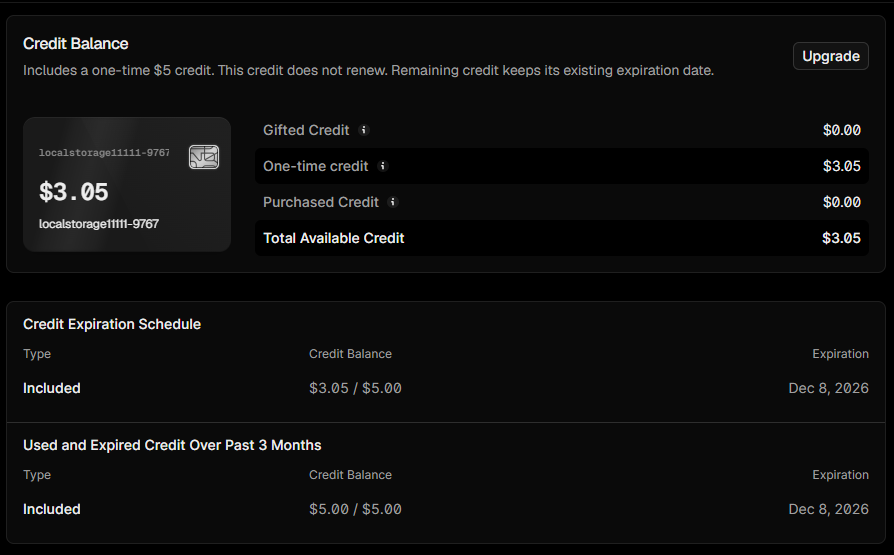
⚠️ The Brutal Truth About v0’s Free Tier: You are on a ticking clock. In just two prompts, building a basic prototype burned 39% of our entire lifetime allowance. Because each complex multi-component generation costs roughly $1.00, v0 gives you approximately 5 prompts for life before you are permanently cut off unless you upgrade to the $20/month Premium plan. If you misspell an instruction or ask for a minor button restyle, you just vaporized 20% of your remaining trial.
Lovable’s Model: 5 Daily Credits with a Hard Ceiling
Lovable operates on a completely different philosophy—the rolling daily credit window:
- Free users receive 5 build credits every 24 hours (resetting at midnight UTC).
- On Prompt 1, Lovable deducted 2.20 credits.
- On Prompt 2, Lovable deducted 2.90 credits.
Total cost: 5.10 credits.
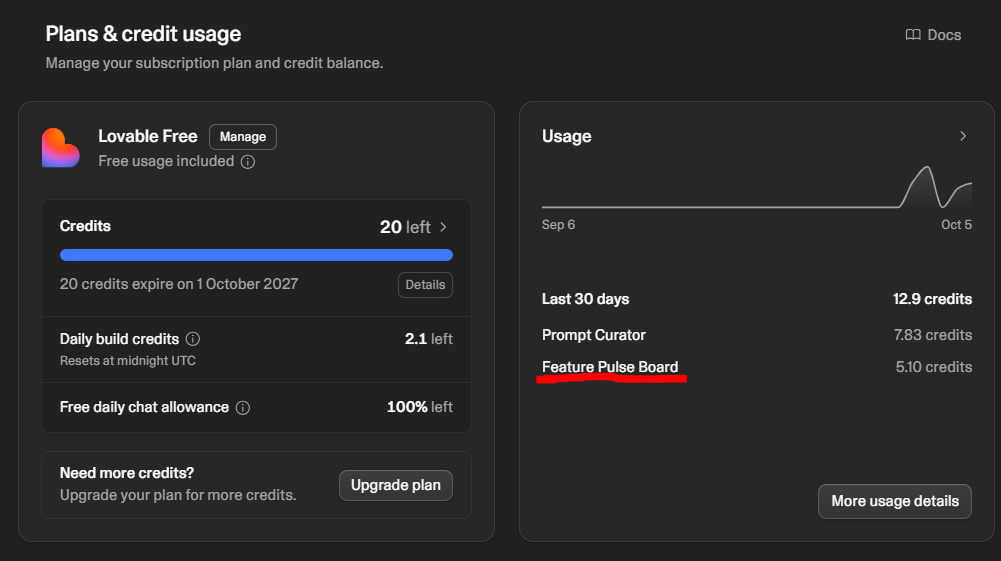
💡 The Brutal Truth About Lovable’s Free Tier: Lovable burned 5.10 credits across two prompts, slightly exceeding our 5-credit daily allowance for a complete build. You cannot build a complex multi-stage app in a single afternoon without hitting the limit: “You have reached your daily credit limit. Credits reset in X hours.” However, Lovable’s credits replenish every single day for $0. Tomorrow morning, you wake up and your 5 credits are back. On v0, tomorrow morning your balance is still $3.05, creeping closer to zero. For bootstrappers, students, and weekend hackers, Lovable provides infinitely more recurring runway.
The Experiment: What We Built
To make the benchmark fair and rigorous, we designed a micro-SaaS called FeaturePulse—a public product roadmap and feature upvoting board (similar to Canny or UserVoice).
| Architecture Layer | Core Components & UI Elements |
|---|---|
| Header & Auth | App branding (“FeaturePulse”), real-time search bar, “+ Submit Feature” CTA, Sign-In modal / user avatar |
| Roadmap Controls | Status filter tabs (All, Under Review, Planned, In Progress, Completed), sorting dropdown, category pills |
| Feature Card Grid | 5 production cards with chevron upvote buttons, status badges, category tags, and comment counters |
| Interactive State | Live client-side upvoting (+1/-1), aggregate hero metric recalculation, and CRUD submission modal |
Why choose a feedback board? Because an upvoting board is the ultimate litmus test for AI builders:
- Relational Data & State: Individual cards have upvote numbers that must increment/decrement, category tags, and comment counts.
- Global Aggregate Metrics: Global dashboard tallies (e.g., total votes across all requests) must stay synchronized with individual card actions.
- Live Filtering & Sorting: Instant search and category tabs require dynamic array filtering without page refreshes.
- Modal CRUD Operations: An accessible “+ Submit Feature” dialog that validates input and dynamically prepends new cards to the live board.
Round 1: Scaffolding & Core UI (Prompt 1)
We submitted the exact same prompt to both platforms to generate the layout, components, and five realistic feature cards. We specifically required production-grade sample requests rather than generic placeholder text:
📋 Copy-and-Paste Prompt: Scaffolding & Core UI (Prompt 1)
“Build a modern, sleek web application called FeaturePulse — an interactive customer feedback and product roadmap voting board (similar to Canny).
Key Requirements:
- Layout & Styling:
- Modern, high-contrast dark-themed SaaS interface using Tailwind CSS and Lucide icons.
- Dark zinc background (#09090b or #18181b), subtle card borders (#27272a), clean typography, and smooth hover transitions.
- Fully responsive layout (desktop and mobile).
- Top Header:
- App branding (“FeaturePulse”) with an electric pulse/activity icon.
- Search bar to search feature requests in real time.
- Primary “+ Submit Feature” button.
- User profile / “Sign In” button in the top right.
- Roadmap Status Tabs & Sorting:
- Status filter tabs with badges showing count: “All Requests”, “Under Review”, “Planned”, “In Progress”, and “Completed”.
- Sort dropdown: “Most Upvoted”, “Newest”, and “Trending”.
- Category tags: “Integrations”, “UI & Design”, “Performance”, and “Security”.
- Feature Request Cards:
- Pre-populate with 5 realistic, production-grade feature requests (e.g., “Webhook triggers for Zapier/Make”, “Export analytics data to CSV/Excel”, “Role-based team access controls”, “Two-factor authentication (2FA)”, “Native desktop app for macOS”).
- Each card must display:
- Prominent upvote button with an up-arrow (▲) and active vote count.
- Title and description excerpt.
- Status badge (with distinct accent colors: Planned = Blue, In Progress = Amber, Completed = Green).
- Category pill.
- Comment count icon with number (e.g., 💬 14 comments).”
v0’s Execution: Precision shadcn Craftsmanship
v0 completed Prompt 1 in 2 minutes and 27 seconds, deducting $0.97 from our balance.
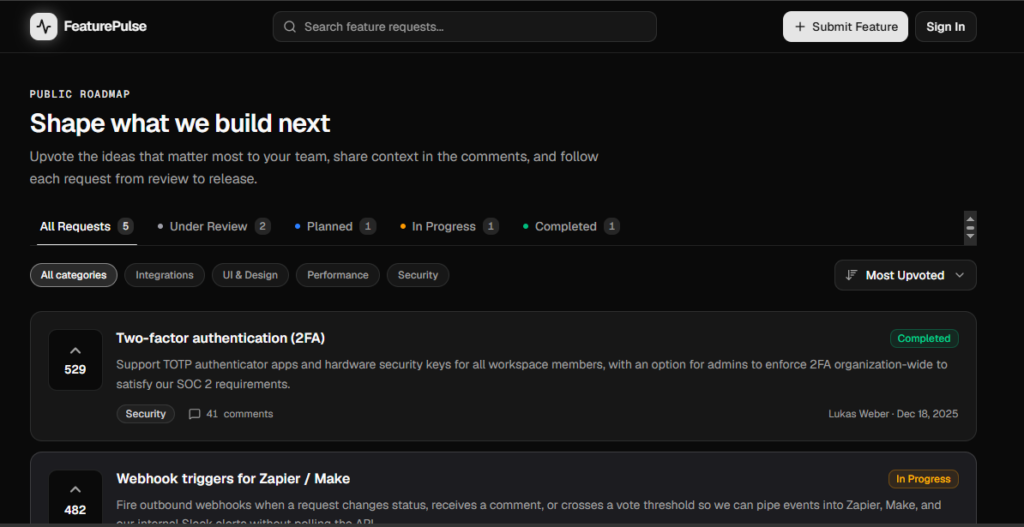
What v0 Did Exceptionally Well:
- The “Vercel Aesthetic”: v0’s visual design was breathtaking. It used true deep-zinc card borders, clean micro-typography, and added an elegant
"PUBLIC ROADMAP"eyebrow tag above the hero title. - Realistic Metadata: Without being asked, v0 populated author names and dates on cards (e.g.,
Lukas Weber • Dec 18, 2025), making the board look like a live production SaaS dashboard rather than a school project. - Architectural Restraint: v0 only authored the exact components needed for this specific page, avoiding boilerplate bloat.
Lovable’s Execution: Proactive SaaS Data Modeling
Lovable completed Prompt 1 in 2 minutes and 35 seconds (just 8 seconds behind v0) and burned 2.20 credits.
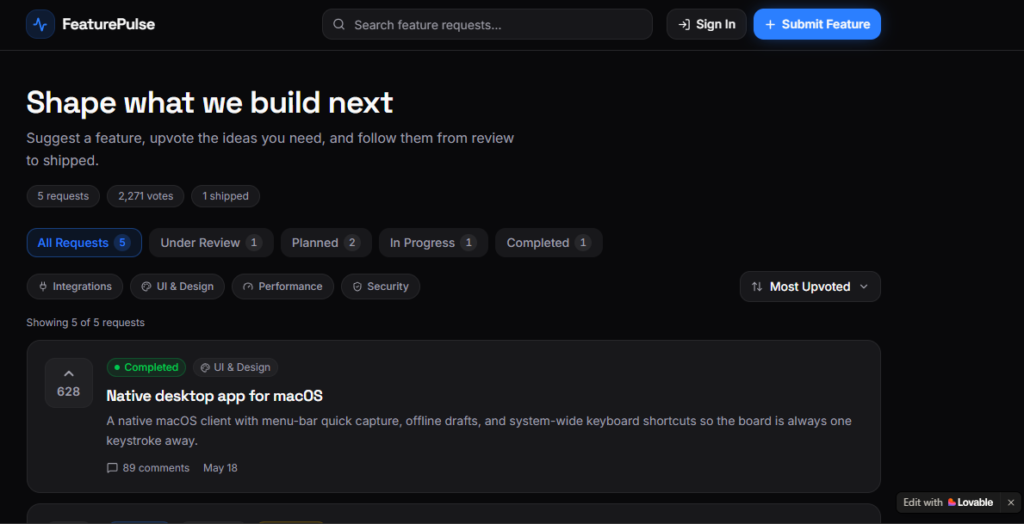
What Lovable Did Exceptionally Well:
- Anticipated SaaS Metrics: Lovable automatically understood what a product roadmap dashboard needs and generated an aggregate metrics row in the hero section:
5 requests | 2,271 votes | 1 shipped. - High-Contrast Design: Lovable utilized bold blue accents for its primary “+ Submit Feature” button and clean pill badges for categories.
- Full-Stack Orientation: Rather than treating the page as a static UI layout, Lovable structured its internal state ready for direct database bindings.
Round 1 Verdict: Tie. v0 edged out Lovable on generation speed (by 8 seconds) and aesthetic nuance, while Lovable demonstrated superior product instinct by modeling aggregate statistics automatically.
Round 2: Interactivity, Upvoting & State Management (Prompt 2)
A common myth among developers is that v0 only builds static UI components, while Lovable builds functional applications.
To stress-test this claim, we submitted Prompt 2 to add client-side upvoting logic, modal dialog forms, real-time filtering, and authentication simulation:
📋 Copy-and-Paste Prompt: Interactivity & State (Prompt 2)
“Let’s add full interactivity, modal actions, and state management to FeaturePulse:
- Interactive Upvoting:
- Clicking any upvote button must immediately increment the vote count by +1 and highlight the button in active blue/indigo. Clicking it again should decrement (-1).
- Upvote counts must update the sorting in real time when “Most Upvoted” is selected.
- “+ Submit Feature” Modal (CRUD):
- Clicking “+ Submit Feature” must open an accessible modal dialog.
- Form fields: Feature Title (input), Category (dropdown: Integrations, UI & Design, Performance, Security), and Description (textarea).
- Submitting the form validates inputs, closes the modal, and immediately prepends the new feature request card to the top of the board with 1 vote.
- Live Search & Status Filtering:
- Typing in the top search bar must filter feature cards in real-time.
- Clicking any status tab (“Planned”, “In Progress”, “Completed”) must filter the visible cards to match that status. Include an empty state with a “Reset Filters” button if no results match.
- Authentication Simulation:
- Clicking “Sign In” in the header opens a login modal with Email/Password and a “Continue with Google” button.
- Submitting updates the header to show a user avatar circle and “Log Out” option.”
The Round 2 Showdown: Who Handled State Better?
Lovable Crushed the Clock:
Lovable completed the entire interactive overhaul in 1 minute and 17 seconds (consuming 2.90 credits).
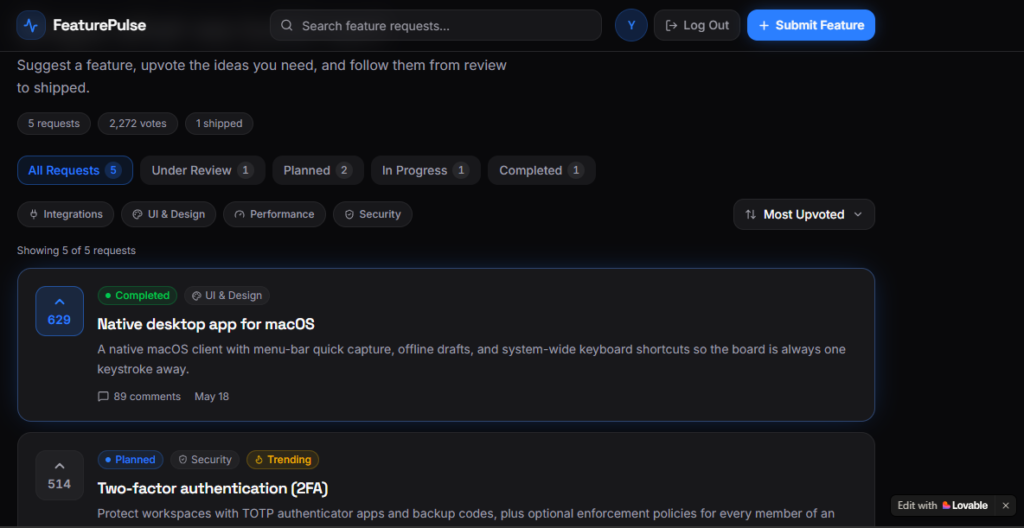
- The Global State Masterstroke: When we clicked the upvote button on “Native desktop app for macOS”, it incremented from 628 to 629 and turned active blue. Crucially, Lovable also incremented the global hero counter from 2,271 to 2,272 votes! It recognized that an individual card vote must trigger a re-render of global dashboard metrics.
- Auth Simulation: Lovable smoothly updated the header button into a circular user avatar (
Y) with an adjacentLog Outbutton.
v0 Proved It Can Handle Real State:
v0 took 2 minutes flat (deducting $0.98).
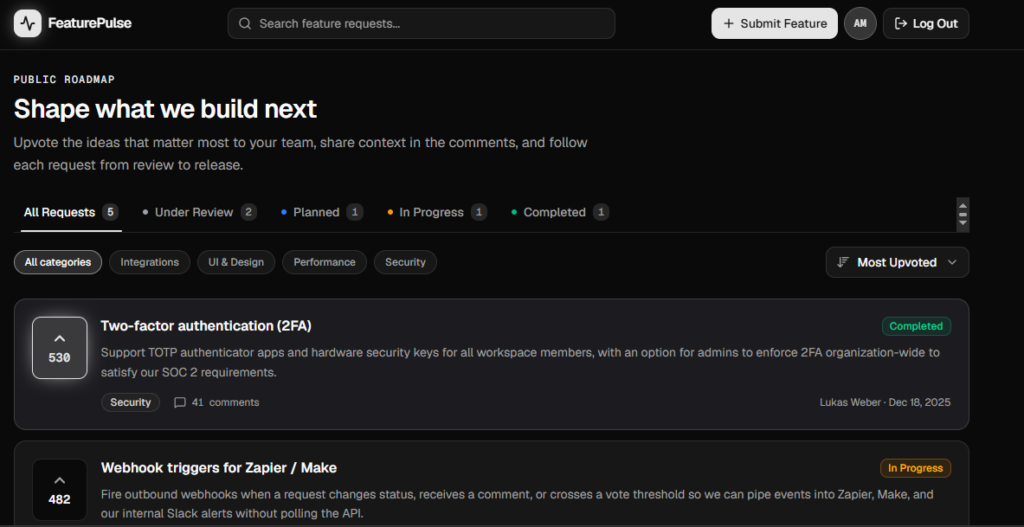
- Debunking the “Static UI” Myth: Contrary to claims that v0 only outputs static mockups, v0 successfully wired interactive React state into its preview. Clicking the upvote on “Two-factor authentication (2FA)” incremented the counter from 529 to 530 and highlighted the box with an elegant glowing white border.
- Clean Modal Handling: v0 wired accessible dialog triggers for both the submit form and login workflows, updating the header to display user initials (
AM) upon submission.
Round 2 Winner: Lovable. While both platforms successfully implemented client-side state, Lovable was 43 seconds faster and demonstrated superior architectural awareness by linking local card votes to global dashboard tallies.
Round 3: The “Local Eject” Audit (The Ultimate Test)
This is where marketing fluff ends and software engineering begins. What happens when you export the code to your local machine and run npm run build?
We exported both codebases:
- Lovable Repository: Publicly exported to GitHub at
localstorage11111-cyber/featurepulse-board. - v0 Export: Downloaded directly as a complete production project package.
We extracted both projects into clean directories, ran npm install, and executed npm run build in our terminal:
| Evaluation Metric | v0 by Vercel | Lovable.dev | The Winner |
|---|---|---|---|
| Local Compilation Status | 🟢 Clean (Exit Code 0) | 🟢 Clean (Exit Code 0) | 🤝 Tie (Both build cleanly) |
| Local Build Duration | 21.6s (Next.js Turbopack) | 8.2s total (Vite + Nitro) | 🟢 Lovable (Faster build) |
| Direct Runtime Dependencies | 🟢 11 packages | 🔴 52 packages | 🏆 v0 (5x leaner codebase) |
| Total Packages Installed | 🟢 363 packages (2 min install) | 🔴 522 packages (4 min install) | 🏆 v0 (Much lighter) |
| Architectural Model | Next.js 16 App Router | TanStack Start + Nitro SSR | Depends on stack |
| Client Production Bundle | 624.77 KB JS (44.9 KB CSS) | 394.73 KB JS (82.5 KB CSS) | 🟢 Lovable (Smaller client JS) |
| Server Engine Bundle | None (Static React SPA) | 1,098 KB (Nitro Server Engine) | 🟢 v0 (Pure SPA simplicity) |
| Deployment Target | Any Next.js host (Vercel) | Cloudflare Workers (wrangler.json) | Depends on stack |
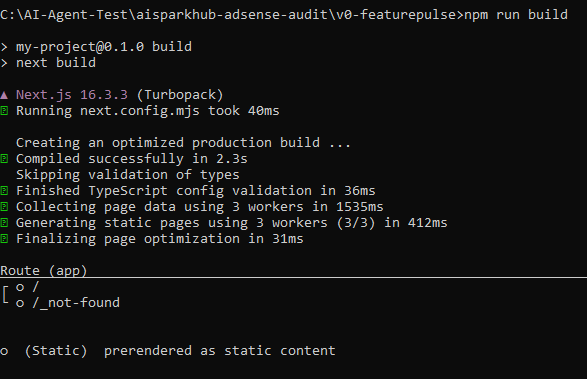
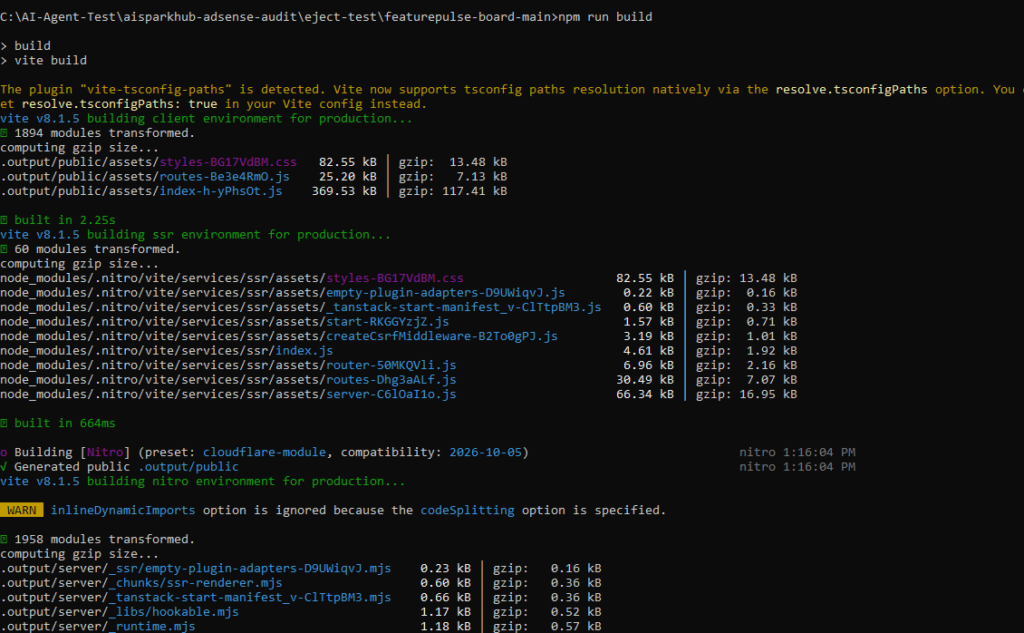
Architectural Analysis: Modular Next.js vs. Enterprise Monolith
The contrast between the two exported codebases was staggering:
1. v0: The Professional Frontend Developer’s Dream
v0 does not dump hundreds of unnecessary packages into your project. It scaffolded a textbook Next.js 16.3 App Router application:
- Only 11 Direct Dependencies:
@base-ui/react,@vercel/analytics,class-variance-authority,clsx,lucide-react,next,react,react-dom,shadcn,tailwind-merge, andtw-animate-css. - Modular Component Architecture: Cleanly organized into
components/(app-header.tsx,board-toolbar.tsx,feature-board.tsx,feature-card.tsx,sign-in-dialog.tsx,submit-feature-dialog.tsx). - Zero Component Bloat: v0 only created
components/ui/button.tsx—the single shadcn component actually utilized by the layout. - Instant Portability: Any engineer working in Next.js or React can copy these components into their existing production project in under two minutes without touching boilerplate.
2. Lovable: The Enterprise Nitro Monolith
Lovable did not generate a simple React app. As we observed in our previous tests on our PromptVault eject audit, Lovable generated an enterprise-scale Server-Side Rendered (SSR) full-stack application powered by TanStack Start, TanStack Router, and Nitro, pre-configured for Cloudflare Workers (wrangler.json).
- 52 Runtime Dependencies: Includes 26
@radix-uiprimitives,@tanstack/react-query,@tanstack/react-router,@tanstack/react-start,zod,react-hook-form,sonner,recharts,date-fns, andembla-carousel-react. - The Entire shadcn Suite: Lovable once again dumped over 40 UI components into
src/components/ui/—including components our application never touched (e.g.,accordion.tsx,alert-dialog.tsx,carousel.tsx,menubar.tsx,slider.tsx). - Heavy Dependency Footprint: Running
npm installrequires 4 minutes to download 522 packages, and the server bundle carries over 1 MB of Nitro runtime code.
The Takeaway: If you want modular, production-ready React/Next.js components to integrate into an existing codebase, v0’s code is dramatically cleaner, leaner, and easier to maintain. But if you want a complete, standalone full-stack SSR application configured for Cloudflare edge deployment with routing and server data fetching out of the box, Lovable’s architecture is an extraordinary foundation.
The Paid Tier Showdown: v0 Pro vs. Lovable Starter
Once you blow past the free tier, what are you actually paying for? Both tools start at around $20 per month, but their value propositions cater to completely different developer mindsets:
| Plan Feature | v0 Premium ($20/mo) | Lovable Starter ($20/mo) |
|---|---|---|
| Monthly Compute Allowance | $20 credit allowance / month | 100 build credits / month |
| Cost Per Complex Prompt | ~$0.50 – $1.00 per generation | ~2.0 – 3.0 credits per generation |
| Estimated Real Generations | 20 – 40 prompts / month | 35 – 50 prompts / month |
| Database Provisioning | 🔴 None (Bring Your Own) | 🟢 Native Supabase (Postgres & Auth) |
| Deployment Integration | 🟢 One-click Vercel Deploy | 🟢 Cloudflare Workers / Custom Domain |
| Code Export | 🟢 ZIP or npx v0 add CLI | 🟢 Direct GitHub Push & Sync |
| Best For | Full-time frontend engineers | Solo founders shipping MVPs |
Which Subscription Gives You Better ROI?
- If you are shipping an MVP from zero: Lovable Starter ($20/mo) gives you far more leverage. Having integrated Supabase, auth tables, and GitHub two-way synchronization means you don’t spend $20 just to get a mockup—you get a live SaaS app taking user sign-ups.
- If you are building an existing product on Next.js: v0 Premium ($20/mo) is unbeatable. You can use the
npx v0 addcommand to pull AI-generated components directly into your local Next.js project like Lego bricks, styled perfectly with Tailwind and shadcn.
The Definitive Decision Matrix
| Choose v0 by Vercel If… | Choose Lovable If… |
|---|---|
| You already have a Next.js / React project and need UI components. | You are building a standalone MVP from scratch. |
| You want clean, modular code with only 11 dependencies. | You want integrated backend, auth, and database (Supabase). |
| You have a paid Vercel subscription and aren’t limited by free credits. | You want daily replenishable free credits (5/day) for testing. |
| You want standard Next.js App Router conventions. | You want an enterprise TanStack Start + Nitro SSR architecture. |
| You prefer styling precision with shadcn/ui and Tailwind. | You want global state and aggregate data modeled automatically. |
When Should You Eject to an IDE (Cursor / VS Code)?
Neither v0 nor Lovable should be used as a permanent replacement for a professional development environment. Based on our empirical testing, here is the exact threshold where you should eject from the browser into Cursor or VS Code:
- When connecting real transactional databases: v0 gives you zero database plumbing. Lovable provisions Supabase, but writing complex SQL joins, Row-Level Security (RLS) policies, or Stripe webhooks inside an AI chat box quickly burns credits.
- When refactoring multi-file logic: In v0, every subsequent prompt burns ~$1.00 of compute. In Lovable, minor CSS tweaks burn 2–3 credits. Ejecting to Cursor allows you to make precision edits locally without paying a recurring AI token tax.
- When pruning bundle bloat: If you build on Lovable, clone the repo locally to delete the 40 unused shadcn components and drop the package footprint from 522 dependencies down to what your app actually needs.
Frequently Asked Questions
Can you build a full-stack SaaS with v0?
v0 specializes in frontend UI components, responsive pages, and client-side interactive state. While it can scaffold complete interfaces and simulate authentication, v0 does not provide built-in managed databases or authentication backends. To make a v0 application a real full-stack SaaS, you must export the code and manually connect an external database (e.g., Supabase, Neon, or Prisma) or Next.js API routes. In contrast, Lovable natively provisions and wires Supabase databases out of the box.
Does v0 have a free plan?
Yes, but with a major limitation: v0 provides a one-time $5.00 credit balance upon sign-up, which does not renew monthly or daily. In our benchmark, building a two-prompt interactive dashboard consumed $1.95 (~39% of the total allowance). In practice, v0’s free tier allows for roughly 5 generations before requiring an upgrade to the $20/month Premium tier.
Is Lovable cheaper than v0?
On paid plans, both tools start at approximately $20 per month. However, on free tiers, Lovable offers significantly more recurring runway. Lovable provides 5 free build credits every single day (refreshing every 24 hours), whereas v0’s $5 free credit is a one-time trial that never replenishes.
Does the exported code run locally without errors?
Yes. In our local terminal audit, both projects compiled with zero errors (Exit Code 0) when running npm run build. v0 compiled via Next.js Turbopack in 21.6 seconds. Lovable compiled via Vite v8 and Nitro SSR in 8.2 seconds.
Is Lovable better than v0 for non-coders?
Yes. Lovable is much friendlier for non-technical founders because it handles deployment, backend databases, and user authentication visually within the browser. v0 produces cleaner React code, but requires technical knowledge to connect a backend and deploy a database.
Final Takeaway & Recommended Workflow
AI web builders have evolved from simple landing-page generators into formidable software scaffolding engines. Both tools successfully took a high-level English prompt and returned a working, responsive application with authentication modals, search filtering, and upvoting state.
If you are starting a new project today, our recommended workflow is:
- Use Lovable to scaffold complete full-stack MVPs: If you are building a product from scratch and need database tables, authentication, and live cloud deployment handled in a single prompt, Lovable is the superior all-in-one platform.
- Use v0 to design production-grade UI components: If you already have a Next.js or React codebase and need a high-fidelity dashboard, settings page, or pricing table with clean shadcn/ui code, v0’s 11-dependency export is the cleanest code on the market.
- Eject early for production scalability: Neither tool should trap your codebase. Both provide clean exports that compile with zero errors locally, allowing you to transition into VS Code or Cursor the moment your core concept is validated.
Tested on October 4–5, 2026 using v0 by Vercel and Lovable.dev free tiers. Codebases archived at localstorage11111-cyber/featurepulse-board.